Why Poland Is Great for Life Sciences: A Deep Dive into a Thriving Ecosystem

Labtree
Team
August 16, 2025
4 minutes
TL;DR
Poland has the people, the labs, the clinical trial throughput, and the money. The evidence points one way: it’s moving from regional player to European life sciences powerhouse.
Poland has the people, the labs, the clinical trial throughput, and the money. The evidence points one way: it’s moving from regional player to European life sciences powerhouse.
Why Poland Is Becoming Europe’s Next Life Sciences Powerhouse
Over the past twenty years, Poland has been quietly reshaping its role in Europe. What was once a market known mainly for affordable manufacturing has evolved into a genuine life sciences hub. The mix is striking: a deep pool of scientists, serious investment in infrastructure, and a venture scene that’s finally catching up.
This isn’t hype or projection. The numbers are already visible in labs, in clinical trial registries, and in funding rounds. Poland is moving into the front rank of European biotech.
Talent: Poland’s Edge
Every innovation economy starts with people. Poland produces them at scale. Each year, universities hand out more than 15,000 degrees in life sciences, from biotechnology and pharmacy to medicine and chemistry. Bring in engineering and computer science, and the figure jumps past 75,000 graduates.
That’s not just volume. These scientists are well trained, fluent in English, and increasingly ambitious. Companies know they can recruit at a level that rivals Western Europe — at 30–40% lower cost. For international biotechs and MedTech firms, this combination of quality and efficiency is rare.
R&D Infrastructure Built for Growth
Poland has matched talent with facilities. Over the past decade, national and EU funds have built modern research hubs in Kraków, Gdańsk, and beyond. These are not empty shells — they house advanced labs, incubators, and partnerships between universities and industry.
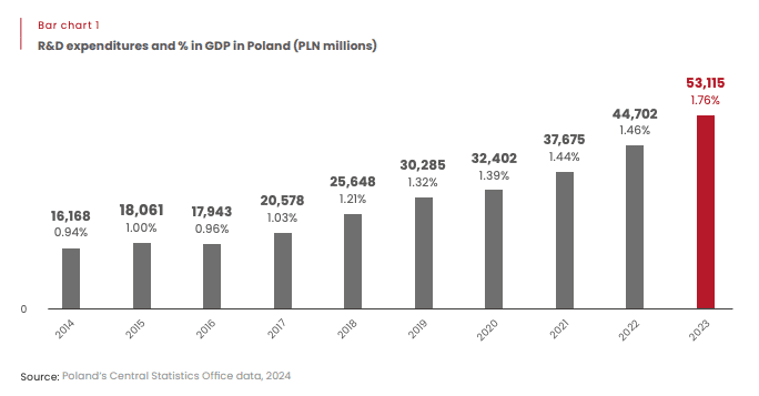
The commitment shows in the numbers. Between 2017 and 2022, national R&D spending more than doubled, from 20.4 to 44.7 billion PLN. That’s 1.46% of GDP and rising. It reflects a clear direction of travel: Poland is aligning its economy around knowledge and innovation, not low-cost production.
Clinical Trials: Fast, Reliable, Competitive
Poland has become one of Europe’s busiest clinical trial markets, and the reasons are pragmatic. A population of nearly 38 million provides both scale and diversity. A centralized healthcare system gives sponsors access to consistent, well-equipped sites. Regulators follow EMA and GCP standards, so data is accepted globally, including by the FDA.
What sponsors value most is speed. Ethics and regulatory approvals are more streamlined than in many Western jurisdictions. In 2024, more than 780 new trials were registered in Poland — a 25% increase over five years. For global pharma and biotech, that efficiency translates directly into saved time and lower risk.
A Diversifying Sector
Poland’s life sciences economy isn’t built on a single pillar. Pharmaceuticals remain strong, with companies like Polpharma and Adamed exporting generics and APIs worldwide. Biotechnology is growing quickly, particularly in oncology, cell therapies, and biologics. Industrial biotech is gaining traction too, from enzymes to sustainable fuels.
MedTech and digital health are expanding fastest. The sector is already worth more than €3 billion, with annual growth projected at 8–10%. Poland’s IT workforce — one of the largest in Europe — is powering AI diagnostics, digital platforms, and remote care solutions.
Geography helps. At Europe’s crossroads, Poland can move sensitive products quickly east or west. Fourteen Special Economic Zones offer tax breaks and grants, encouraging international companies to anchor manufacturing here.
Capital Steps Up
For years, venture funding was the weakest link. That’s changing. In 2024, life sciences companies in Poland raised more than €150 million — five times the 2019 figure. The state-backed PFR Ventures fund of funds has anchored dozens of local VCs, lowering risk for early-stage deals and giving founders more options.
The funding stack now runs deeper: NCBR grants and EU Horizon programs cover early research, while domestic and international VCs write bigger checks for scale. Several Polish biotechs have already raised substantial rounds or gone public on the Warsaw Stock Exchange, proving that credible outcomes don’t require relocating abroad.
What Comes Next
Poland’s government has declared biotech and health tech strategic priorities. With steady investment in education, infrastructure, and funding mechanisms, the foundations are set.
The most interesting opportunities will come where Poland’s two strengths meet — biology and IT. Expect advances in AI-enabled drug discovery, personalized medicine, and advanced manufacturing. These aren’t long-shot ambitions; they’re the natural extensions of where the ecosystem is already heading.
Conclusion
Poland now combines scientific talent, modern infrastructure, clinical trial throughput, and capital depth. For researchers, entrepreneurs, and investors, it offers a fast-moving and cost-efficient environment that is plugged into global standards.
The shift is clear. Poland is no longer an emerging player in European life sciences. It’s becoming one of its leaders.
Never miss an update
Get all the news and updates about Labtree, directly to your inbox.
Never miss an update
Get all the news and updates about Labtree, directly to your inbox.
SHARE THIS POST
SHARE THIS POST
Never miss an update
Get all the news and updates about Labtree, directly to your inbox.
Why Poland Is Great for Life Sciences: A Deep Dive into a Thriving Ecosystem
Labtree
Team
August 16, 2025
4 minutes
TL;DR
Poland has the people, the labs, the clinical trial throughput, and the money. The evidence points one way: it’s moving from regional player to European life sciences powerhouse.
Why Poland Is Becoming Europe’s Next Life Sciences Powerhouse
Over the past twenty years, Poland has been quietly reshaping its role in Europe. What was once a market known mainly for affordable manufacturing has evolved into a genuine life sciences hub. The mix is striking: a deep pool of scientists, serious investment in infrastructure, and a venture scene that’s finally catching up.
This isn’t hype or projection. The numbers are already visible in labs, in clinical trial registries, and in funding rounds. Poland is moving into the front rank of European biotech.
Talent: Poland’s Edge
Every innovation economy starts with people. Poland produces them at scale. Each year, universities hand out more than 15,000 degrees in life sciences, from biotechnology and pharmacy to medicine and chemistry. Bring in engineering and computer science, and the figure jumps past 75,000 graduates.
That’s not just volume. These scientists are well trained, fluent in English, and increasingly ambitious. Companies know they can recruit at a level that rivals Western Europe — at 30–40% lower cost. For international biotechs and MedTech firms, this combination of quality and efficiency is rare.
R&D Infrastructure Built for Growth
Poland has matched talent with facilities. Over the past decade, national and EU funds have built modern research hubs in Kraków, Gdańsk, and beyond. These are not empty shells — they house advanced labs, incubators, and partnerships between universities and industry.
The commitment shows in the numbers. Between 2017 and 2022, national R&D spending more than doubled, from 20.4 to 44.7 billion PLN. That’s 1.46% of GDP and rising. It reflects a clear direction of travel: Poland is aligning its economy around knowledge and innovation, not low-cost production.
Clinical Trials: Fast, Reliable, Competitive
Poland has become one of Europe’s busiest clinical trial markets, and the reasons are pragmatic. A population of nearly 38 million provides both scale and diversity. A centralized healthcare system gives sponsors access to consistent, well-equipped sites. Regulators follow EMA and GCP standards, so data is accepted globally, including by the FDA.
What sponsors value most is speed. Ethics and regulatory approvals are more streamlined than in many Western jurisdictions. In 2024, more than 780 new trials were registered in Poland — a 25% increase over five years. For global pharma and biotech, that efficiency translates directly into saved time and lower risk.
A Diversifying Sector
Poland’s life sciences economy isn’t built on a single pillar. Pharmaceuticals remain strong, with companies like Polpharma and Adamed exporting generics and APIs worldwide. Biotechnology is growing quickly, particularly in oncology, cell therapies, and biologics. Industrial biotech is gaining traction too, from enzymes to sustainable fuels.
MedTech and digital health are expanding fastest. The sector is already worth more than €3 billion, with annual growth projected at 8–10%. Poland’s IT workforce — one of the largest in Europe — is powering AI diagnostics, digital platforms, and remote care solutions.
Geography helps. At Europe’s crossroads, Poland can move sensitive products quickly east or west. Fourteen Special Economic Zones offer tax breaks and grants, encouraging international companies to anchor manufacturing here.
Capital Steps Up
For years, venture funding was the weakest link. That’s changing. In 2024, life sciences companies in Poland raised more than €150 million — five times the 2019 figure. The state-backed PFR Ventures fund of funds has anchored dozens of local VCs, lowering risk for early-stage deals and giving founders more options.
The funding stack now runs deeper: NCBR grants and EU Horizon programs cover early research, while domestic and international VCs write bigger checks for scale. Several Polish biotechs have already raised substantial rounds or gone public on the Warsaw Stock Exchange, proving that credible outcomes don’t require relocating abroad.
What Comes Next
Poland’s government has declared biotech and health tech strategic priorities. With steady investment in education, infrastructure, and funding mechanisms, the foundations are set.
The most interesting opportunities will come where Poland’s two strengths meet — biology and IT. Expect advances in AI-enabled drug discovery, personalized medicine, and advanced manufacturing. These aren’t long-shot ambitions; they’re the natural extensions of where the ecosystem is already heading.
Conclusion
Poland now combines scientific talent, modern infrastructure, clinical trial throughput, and capital depth. For researchers, entrepreneurs, and investors, it offers a fast-moving and cost-efficient environment that is plugged into global standards.
The shift is clear. Poland is no longer an emerging player in European life sciences. It’s becoming one of its leaders.
Never miss an update
Get all the news and updates about Labtree, directly to your inbox.
SHARE THIS POST
SHARE THIS POST
Never miss an update
Get all the news and updates about Labtree, directly to your inbox.